30–60s Answer to 'Why Hire You' for Firefighter Boards, Example First

30–60s Answer to ‘Why Hire You’ for Firefighter Boards, Example First
The strongest answer connects one specific skill or experience to a real department need, backs it with a short example, and closes with a line about sticking around and growing with the crew. Something like: “I bring hands on EMT experience and a track record of staying calm under pressure, and I want to build a long career serving this community.” (Swap in your own background, whether that’s military service, volunteer time, or physical training.) The sections below give you the reasoning, the structure, and enough sample answers to help you build your own version fast.
TL;DR:
- Candidates should include a real, verifiable example demonstrating their skills or experience rather than relying on vague statements.
- Answers must directly relate specific skills or experiences to the department’s known needs and community focus.
- Practicing out loud and receiving objective feedback improves clarity, timing, and confidence more than silent rehearsals.
- Tailoring responses to the department’s mission and recent initiatives shows genuine research and increases credibility.
- Using a structured four-part format—claim, example, department tie-in, and commitment—helps keep answers focused and concise within 30 to 60 seconds.
Table of Contents
- What Makes a “Why Should We Hire You Firefighter” Answer Land
- How to Structure a “Why Should We Hire You” Answer
- Sample Answers by Background, With Scoring Notes
- Bad Answers That Cost Points, and How to Fix Them
- Tailoring Your Answer to the Department
- Why Speaking Your Answer Out Loud Beats Silent Rehearsal
- What Actually Convinces a Panel
- Try a Scored Mock Oral Board Before the Real One
- Sources
- FAQ
What Makes a “Why Should We Hire You Firefighter” Answer Land
Panels are not grading enthusiasm. They are grading proof. Before you write a single word of your answer, run through this checklist and make sure you can back each item with a real sentence, not a vague claim.
- Teamwork and communication. Don’t just say you’re a team player. Describe a moment where you had to coordinate with others under stress, like leading a work crew through a deadline or organizing volunteers during a community cleanup.
- Certifications and training. Name what you actually hold. Firefighter I/II, CPR, EMT-Basic or EMT-Paramedic, HAZMAT awareness. If you’re still working toward one, say so directly and give a timeline.
- Physical readiness. State your routine in one line without turning it into a workout log. “I train five days a week with a focus on functional strength and cardio endurance” says enough.
- Relevant experience. Volunteer firefighting, ride-alongs, station visits, EMT shifts, or military service all count. Panels want to see you’ve been near the job, not just admired it from a distance.
- Commitment and adaptability. Say plainly that you’re looking for a career, not a stepping stone. Mention you understand shift work, callouts, and the physical toll, and that you’re prepared for it, grounded in traditions like the patron saint of firefighters who symbolize courage and protection.
Each of these items should compress into a single supporting sentence you can say out loud without stumbling. If you can’t tighten it that much, you probably don’t understand it well enough yet. Concrete credentials and demonstrable field experience are exactly what stand out in hiring evaluations, and a checklist like this keeps your answer grounded instead of generic.
How to Structure a “Why Should We Hire You” Answer
Memorize a four-part template and you’ll never freeze on this question again. It also keeps you from rambling, which is the fastest way to lose points.
- Claim. State your core strength in one sentence. “I bring three years of EMT experience and a calm decision-making style under pressure.”
- Example. Prove it with a specific moment. “Last year I managed a multi-patient car accident scene solo for six minutes before backup arrived, and every patient was stabilized and transported.”
- Tie to the department. Connect the strength to what this department actually needs. “That kind of composure matters here, especially with your call volume on the east side.”
- Commitment. Close with intent. “I’m looking to build a full career here, not just get my foot in the door.”
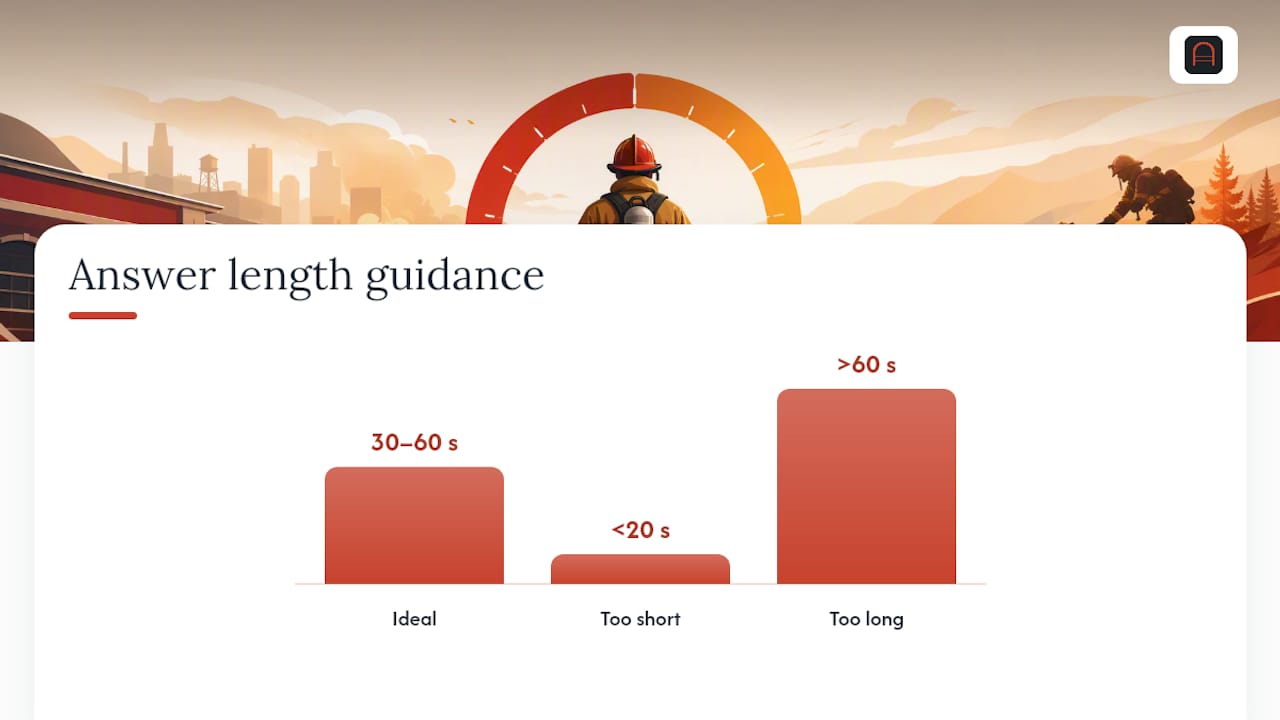
Aim for 30 to 60 seconds total. Longer than that and you start repeating yourself or drifting into filler, which reads as nerves even when it isn’t. Shorter than 20 seconds and it sounds like you didn’t take the question seriously.
If you’re entry-level, lean harder on training and volunteer time in the example step. If you’re experienced, use the example step to show a result, not just an action. Interviewers are listening for specificity, something they could verify if they called your references, and whether your story centers on the team or just on you.
Pro Tip: Say your answer out loud at least ten times before your interview. Reading it silently tricks you into thinking it’s shorter and smoother than it actually is.
Sample Answers by Background, With Scoring Notes
Real answers beat theory. Here’s how this sounds across different candidate backgrounds, along with notes on why each one would score well.
Entry-level candidate: “I’ve completed Firefighter I and II and I’m CPR certified. I’ve done four ride-alongs with Engine 12 and spent two years volunteering with my local search and rescue team, where I learned how to follow instructions exactly under pressure. I’m ready to bring that discipline here and grow into a long career.” Scoring note: strong because it names specific credentials and ties volunteer time to a transferable trait (following instructions under pressure) instead of a vague “I’ve always wanted this.”
EMT background candidate: “As a working EMT-B for two years, I’ve run over 200 medical calls, including cardiac arrests and pediatric emergencies. That means I can hit the ground running on the medical side of your calls, which frees up your senior crew to focus on suppression and rescue.” Scoring note: panels like this because it quantifies experience and explains a concrete operational benefit to the department, not just personal readiness.
Military background candidate: “I spent four years in the Army as a squad leader, responsible for six soldiers in high-stress, high-stakes environments. That taught me how to give and follow orders instantly and how to keep a team functioning when things go sideways. I see firefighting as a natural continuation of that mission.” Scoring note: translating “chain of command” into a firefighting context, rather than just listing military service, shows the candidate has thought about the transfer, not just the resume line.
Experienced candidate (lateral transfer or veteran firefighter): “I’ve spent six years as a firefighter-paramedic, and in that time I’ve mentored three new hires through their probation year, two of whom are now training officers themselves. I bring both hands-on technical skill and a track record of building up the people around me.” Scoring note: mentorship is a signal panels weight heavily because it shows leadership without requiring a title, and it points to a candidate who strengthens the whole crew over time, not just their own shift.
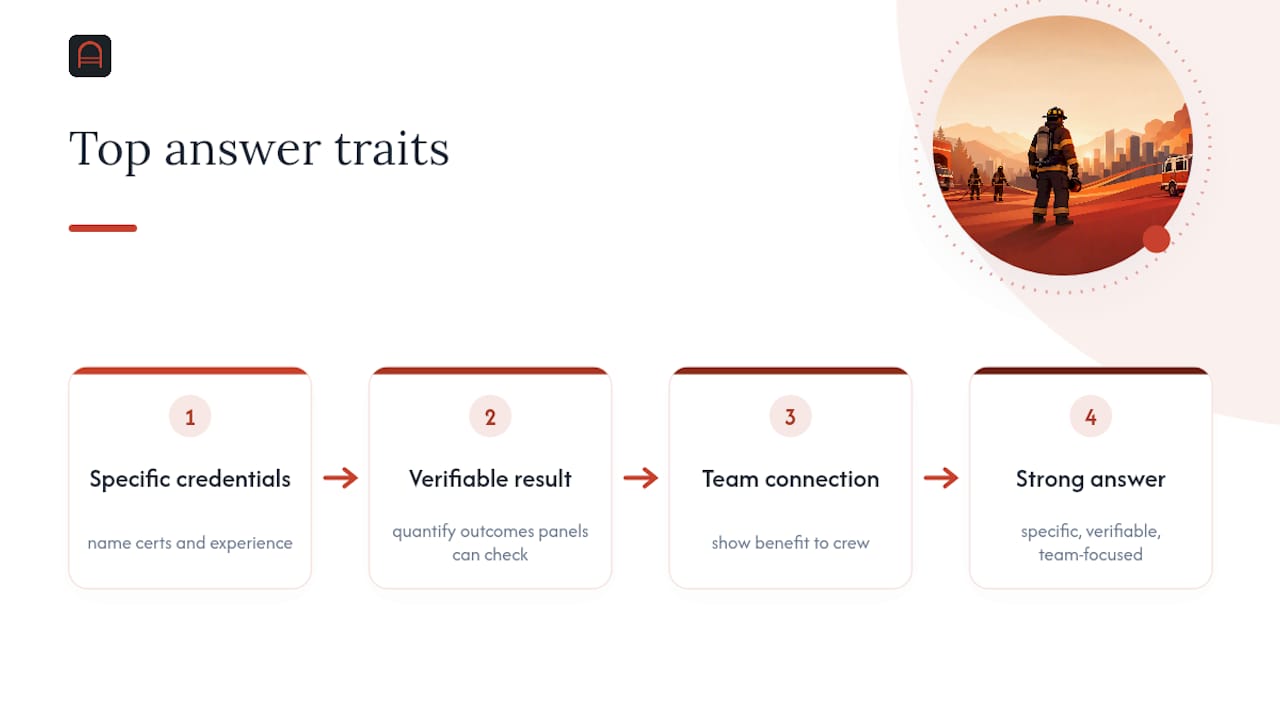
Across every one of these, the highest-scoring answers share three traits: they name something specific, they include a result a panel could theoretically verify, and they connect back to the team rather than staying purely personal. That pattern holds whether you’re 22 with zero paid experience or 34 with a decade in EMS.
Bad Answers That Cost Points, and How to Fix Them
Panels sit through dozens of interviews a day. They hear the same weak answers over and over, and they notice instantly when a candidate is coasting on generic enthusiasm.
- “I’ve always wanted to help people.” This says nothing verifiable. Fix: “I spent two years as a hospice volunteer, and it showed me I want a career built around showing up for people on their worst day.”
- Leading with pay, benefits, or the pension. Even if it’s true, saying it first signals the department is a means to an end. Fix: talk about the mission and community first, and let compensation stay unspoken unless asked directly.
- Exaggerated or unverifiable claims. “I’m the best candidate you’ll see all week” invites a follow-up question you can’t answer well. Fix: stick to claims you could back up with a name, date, or number.
- Badmouthing a previous employer or crew. This is a red flag panels remember. Fix: reframe any past conflict as a lesson learned, focused on what you’d do differently.
Vague, passion-only answers consistently score lower than answers tied to a concrete experience or training milestone, because panels have no way to verify enthusiasm but can easily verify a story with specific details.
Tailoring Your Answer to the Department
A generic answer works everywhere and impresses nowhere. Spend 30 minutes before your interview on the department’s website and recent local news.
- Look for the department’s stated mission and values, usually on an “about” or “careers” page.
- Note any community programs, like fire safety education, CPR classes for residents, or youth mentorship.
- Check for recent incidents or coverage that hint at current priorities, such as wildfire response or a new EMS partnership.
Then fold that into your answer naturally: “I read that your department runs a junior firefighter program, and mentoring through Explorer posts is part of why I want to build a career specifically here.” Don’t fake familiarity you don’t have. One accurate detail beats five name-drops that sound rehearsed. Departments often signal their priorities through community initiatives and recent projects, and echoing that language shows genuine research rather than a copy-paste answer.
Why Speaking Your Answer Out Loud Beats Silent Rehearsal
Reading your answer in your head feels like practice. It isn’t. Your brain fills in gaps that your mouth will trip over later, which is why candidates who sound confident on paper often freeze in the actual chair.
Set up a 20 to 30 minute session focused entirely on this one question. Say your answer out loud five separate times, changing small details each round so it doesn’t sound memorized. Then get scored feedback, not just a gut check from a friend, on specificity, timing, and confidence.
- Track your time. If you’re consistently over 60 seconds, cut detail, not substance.
- Track your specificity. Did you name a real example, or did you drift into generalities halfway through?
- Track your confidence markers. Filler words, trailing sentences, and rising pitch on statements all signal nerves a panel will notice.
Pro Tip: Record yourself once a week during prep, not just once before the interview. Comparing week one to week three shows you exactly where you’re improving and where you’re stuck.
Candidates who rehearse answers out loud and get objective feedback tend to show clearer, faster gains in timing and clarity than those who only read or think through their answers silently. That’s the whole logic behind scored mock interviews. A platform like Stationvisit exists specifically to close that gap between what you think you sound like and what a panel actually hears.
What Actually Convinces a Panel
Sitting across from a candidate, you can tell within the first fifteen seconds whether they’ve practiced out loud or just thought about the question in the shower. The ones who land the job aren’t the most polished talkers. They’re the ones who give you one real example instead of five adjectives.
Keep every answer team-focused and back it with something a panel could verify if they picked up the phone. Then say it out loud, more than once, before you ever sit in that chair.
— Luke
Try a Scored Mock Oral Board Before the Real One
You don’t have to guess whether your “why should we hire you” answer actually works. A realistic mock panel interview platform allows you to speak your answer out loud and get scored against a rubric built from real fire service standards, not generic tips pulled from a video.
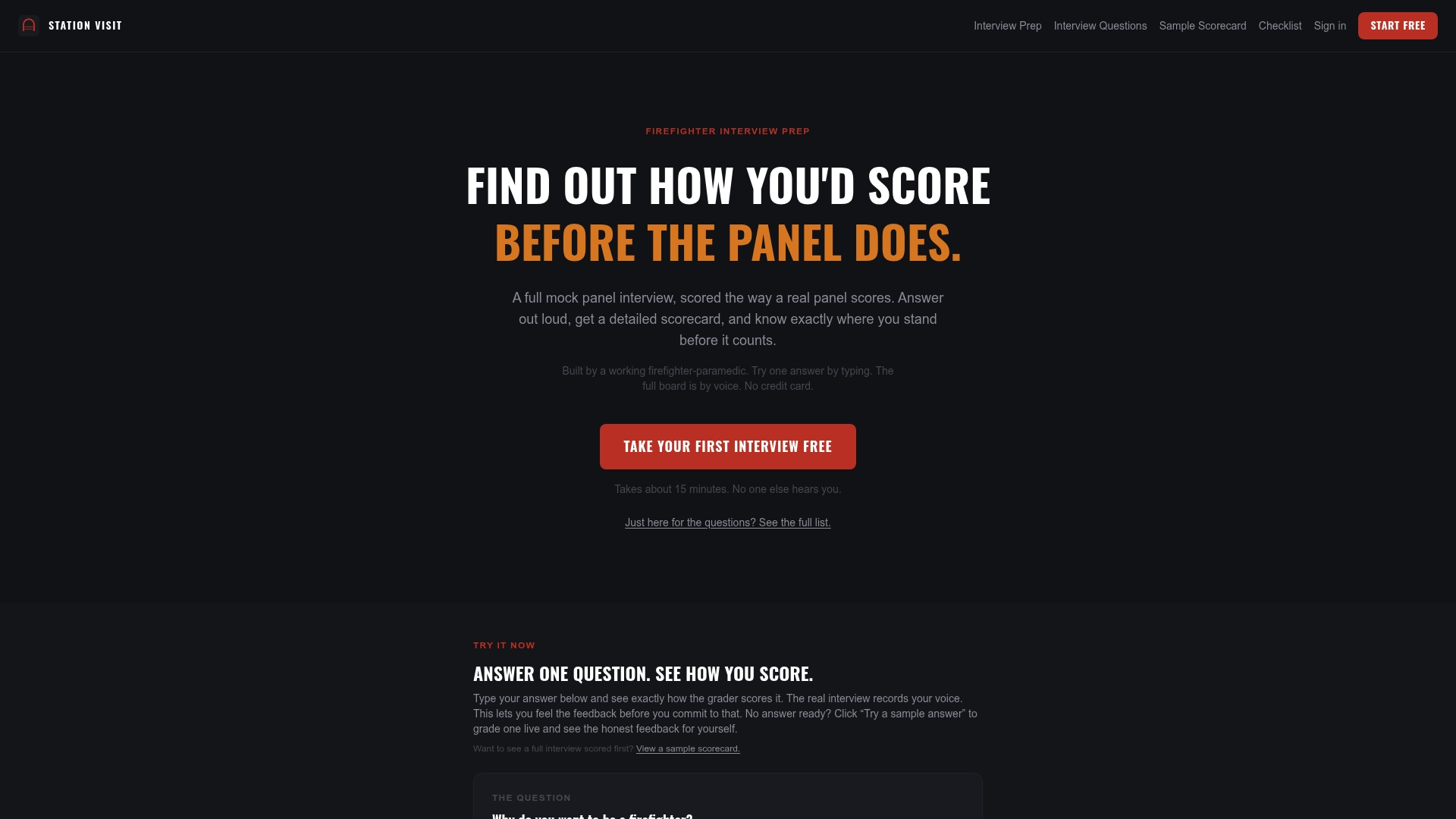
Some platforms let you load custom questions specific to the department you’re applying to, so you’re not just practicing generic prompts. Your first mock interview is free, which is enough to test one version of your “why hire you” answer and see exactly where it’s losing points on clarity, timing, or specificity. If it helps, you can move into a paid plan: Monthly access runs $34 a month, a 3-Month Access pass is a one-time $89, or you can commit for the year at $199. Head to the upgrade page to pick the option that fits your timeline, whether your interview is next week or next season.
Sources
For more sample questions and rubric-style breakdowns, Indeed’s firefighter interview guide and Firehouse’s list of candidate differentiators are worth a full read. For structured practice with scoring, browse Stationvisit’s oral board question bank.
- 15 Toughest Firefighter Interview Questions
- 25 Reasons To Hire You As A Firefighter
- The Reasons to Hire YOU as a Firefighter
FAQ
What Is a Good Answer to “Why Should We Hire You”?
A good answer names one specific skill or experience, backs it with a short concrete example, and ties it to the department’s actual needs before closing with a statement of long-term commitment. Vague claims about “wanting to help people” score lower than answers built around a real event or milestone.
Why Do You Want to Be a Firefighter, and How Should I Answer It?
Panels want to hear motivation tied to a specific experience, like a ride-along, volunteer role, or a personal encounter with emergency services, rather than a general statement about liking to help. Framing your motivation around service, training, and community involvement consistently reads as more genuine than broad statements about passion.
Why Should We Hire You? What Gets a Top Score?
Top-scoring answers are specific, verifiable, and team-focused rather than personal or generic. Panels tend to reward candidates who mention concrete credentials, volunteer or station experience, and a clear plan for continued training, since that combination signals both readiness and staying power.
What Is a Good Reason to Be a Firefighter?
A strong reason connects your personal history to the job’s actual demands, such as prior emergency response experience, a family history of service, or hands-on volunteer work in your community. Community and volunteer contributions can carry real weight in scoring when they’re framed as specific actions rather than general statements of interest.
How Can I Practice My Answer Before the Real Interview?
The fastest way to improve is to speak your answer out loud and get scored feedback on clarity, timing, and specificity rather than just rehearsing silently. Some services offer free scored mock oral board interviews, letting you test a full answer under realistic conditions before your actual panel date.